
Regulatory Compliance Matrix
Regulatory Compliance Matrix: Enterprise AI Guardrails
The Compliance Gap: Best Effort vs.
Absolute Enforcement
Traditional AI security relies on "best-effort" application-layer tools that operate on probabilistic detection. Emerging regulations, however, demand that high-risk AI systems possess "fail-safe" mechanisms and "ground-truth" robustness. Sevorix closes this gap by moving enforcement to the OS kernel, providing the deterministic proof-of-control required by the EU AI Act and NIST.
Article 15 of the EU AI Act mandates that "high-risk" AI systems must be designed to achieve an appropriate level of robustness and cybersecurity. Sevorix serves as the foundational technical fail-safe for Article 15 compliance.
EU AI Act Mandate (Art. 15)
Sevorix Technical Fulfillment
Regulatory Impact
Robustness Against Errors
Moves enforcement below the agent layer to watch ground-truth kernel behavior (network, file, syscalls).
Ensures system integrity even if the primary AI agent or prompt guardrails are bypassed.
Fail-Safe & Fail-Closed
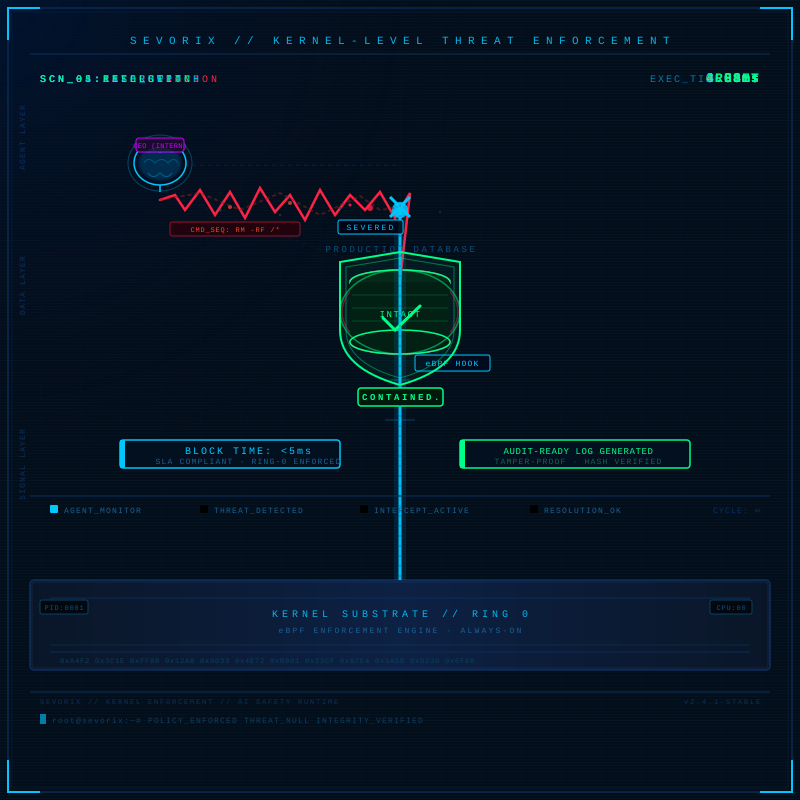
Uses eBPF hooks to monitor and kill unverified connections or unauthorized file access in real-time.
Satisfies the requirement for systems to operate within safe
Fail-Safe & Fail-Closed
Uses eBPF hooks to monitor and kill unverified connections or unauthorized file access in real-time.
Satisfies the requirement for systems to operate within safe parameters even during an outage or attack.
The NIST AI RMF is the gold standard for institutional AI trust. Sevorix specifically addresses the Measure and Manage functions of the framework by providing auditable telemetry that is independent of the AI agent's logic.
The Status Quo: You write a system prompt telling the agent "don't exfiltrate data."
The Failure: Prompt injection and semantic jailbreaks can bypass these instructions. You are asking a probabilistic system to police itself.
The Sevorix Win: We don't care what the agent "intends." If the code attempts an unauthorized connect() at the kernel level, the circuit breaker trips. Period.
NIST AI Risk Management Framework (RMF) Mapping
The NIST AI RMF is the gold standard for institutional AItrust. Sevorix specifically addresses the Measure and Managefunctions of the framework by providing auditable telemetry that is independentof the AI agent's logic.
1. The Measure Function: Ground-Truth Telemetry
- Auditability: Sevorix captures definitive telemetry of what the machine actually does at the kernel level—not just what the agent reports.
- Behavioral Verification: Monitors network calls, file access, and system calls to measure real-time compliance with internal security policies.
- Un-bypassable Logs: Because telemetry is collected in the kernel (Ring-0), logs cannot be tampered with or disabled by a compromised agent process.
2. The Manage Function: Deterministic Controls
- Deterministic Infrastructure: Converts probabilistic AI "decisions" into binary enforcement at the infrastructure level.
- Ring-0 Guardrails: Implements a "much stronger control boundary" by watching processes and system calls directly.
- Runtime Verification: Serves as a required safety layer for companies handing AI agents the keys to CI/CD pipelines and cloud infrastructure.
By leveraging eBPF, Sevorix shifts the enterprise security boundary from "trusting the agent" to "verifying the infrastructure". This shift is the fundamental requirement for achieving compliance in the era of autonomous, agentic workflows.