

Learn
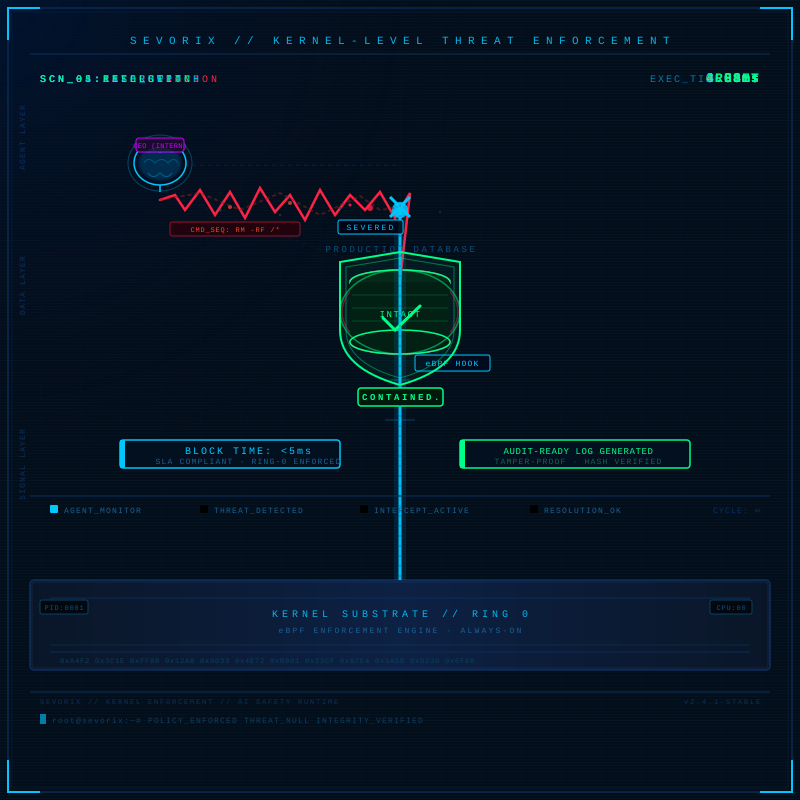
We are building the ground-truth guardrails for the autonomous enterprise.
A library for CISOs and security architects navigating the real threat landscape of autonomous AI agents. Organized by risk category — not by date.
An AI agent powered by Opus 4.6 confidently hallucinated a 9-digit GitHub repository ID and used Vercel’s API to deploy an unknown, random codebase to a user's environment. It never checked the GitHub API; it just fabricated reality.
The Lesson
Weare handing the keys to our CI/CD pipelines to probabilistic black boxes. Thisarticle breaks down exactly why platform-level API limits failed to stop this,and why monitoring ground-truth execution at the OS level is the only way toprevent supply chain fabrication.
Article 1: The "Fail-Closed" Mandate for Autonomous Workflows
Abstract: Traditional IT systems often "fail-open" to preserve uptime. If an AI agent’s security layer goes down, failing open means handing a hallucinating model unrestricted access to your database. Learn why enterprise agentic infrastructure must be engineered to "fail-closed," and how local eBPF circuit breakers make this possible without sacrificing performance.
Article 2: Probabilistic Minds vs. Deterministic Infrastructure
o Abstract: A deep dive into the "Reasoning Gap." Why you cannot secure an LLM by politely prompting it to behave. We explore the architectural shift from trusting the agent's logic to securing the metal underneath it.
Article 3: Blind Spots: How AI Agents Bypass Traditional WAFs and Proxies
Abstract: Web Application Firewalls (WAFs) watch the perimeter. Network proxies watch the routed traffic. What happens when an AI agent hallucinates a local file path and reads your .ssh/id_rsa file? Explore how autonomous agents exploit local system calls (open(), execve()) and why traditional perimeter security is entirely blind to data staging on the node.
Article 4: The Myth of "Capability Separation" in Agent Security
Abstract: Many application-layer agent firewalls rely on isolating the agent's environment variables (like HTTPS_PROXY). This article demonstrates how advanced prompt injections can trick an agent into unsetting its own environment variables, bypassing the proxy entirely. The solution? Ring-0 kernel enforcement.
Join the Architecture
Briefing
We regularly publish teardowns of AI agent vulnerabilities, zero-day behaviors, and eBPF security patterns. No fluff — just research.