

Whitepaper: Bridging the Reasoning Gap
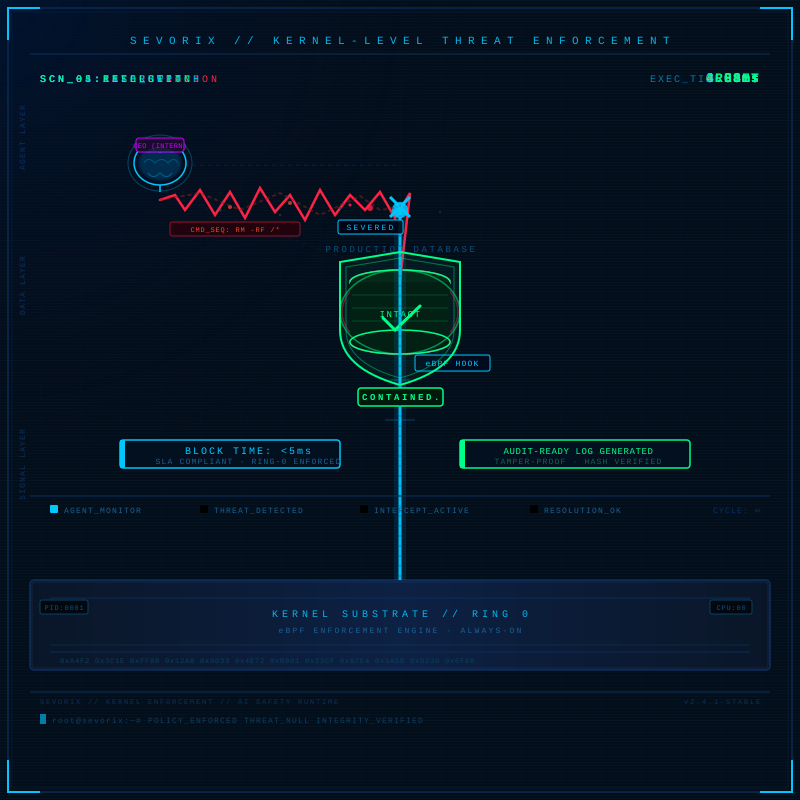
The Case for Kernel-Level Determinism in Agentic AI
The Probabilistic Fallacy
The modern enterprise is built on deterministicinfrastructure—code, databases, and networks that operate on binary logic.However, we are now integrating probabilistic reasoning engines (LLMs)into the heart of these systems.
The "Reasoning Gap" is the space between what anAI agent intends to do and what it actually executes. Because AI models operateon statistical likelihoods, they are prone to hallucinations, promptinjections, and logic failures that traditional security tools—designed forpredictable, human-written code—are blind to.
The Sevorix Thesis: You cannot secure a probabilisticsystem using probabilistic tools. To protect deterministic infrastructure, theenforcement layer must exist at the only ground-truth level: The OperatingSystem Kernel.
Ring-0: The Final Arbiter vs. Application Proxies
Traditional "Agent Firewalls" operate primarily asapplication-layer proxies. While these tools provide valuable contentinspection, they suffer from a fundamental architectural weakness: they are bypassable.
As noted in the documentation for current proxy-basedsolutions, they often do not sandbox processes or restrict system calls(syscalls). They rely on "capability separation," which requires theagent to be manually restricted from the network—a configuration that can beundone by a sophisticated injection or a simple environment variable change.
Sevorix operates at Ring-0 using eBPF. Ground-TruthVisibility: We don't watch the agent's "intent"; we watch itssystem calls. We monitor connect(), open(), and execve() directly in thekernel.
- Inherent Enforcement: Because the kernel is the final arbiter of all hardware and network resources, a Sevorix circuit-breaker cannot be "ignored" or bypassed by the agent's logic.
- Zero-Latency Resilience: By running in-kernel, we eliminate the hop-by-hop latency of proxy-based inspection, ensuring that security keeps pace with high-frequency autonomous workflows.
Consensus over Guessing: The "Jury of Rivals"
To move beyond "best-effort" security, Sevorixintroduces a multi-layered consensus engine known as the Jury of Rivals.This architecture ensures that no single, fallible engine determines the safetyof a high-risk action.
- The Local Observer (SLM): A local, specialized Small Language Model monitors syscall patterns via a local UNIX socket. It provides high-speed, low-latency behavioral analysis without sending data outside your perimeter.
- The Deterministic Rulebook: A set of immutable, kernel-enforced policies that define hard boundaries (e.g., "Outbound traffic permitted to Stripe API only," "Zero access to root-level system files").
- The Consensus Circuit-Breaker: Before a syscall is allowed to complete, the Jury must reach a consensus. If the SLM detects a hallucination or the deterministic rules are violated, the eBPF hook trips the circuit-breaker instantly, killing the connection before any data is exfiltrated.
Securing the future of AI requires moving from "detect and alert" to "enforce and protect." By bridging the Reasoning Gap at the kernel level, Sevorix provides the robustness and fail-safe mechanisms mandated by emerging standards like Article 15 of the EU AI Act.
Stop trusting the agent's logic. Start securing the infrastructure underneath it.